Showing posts with label Wild Bird Wednesday. Show all posts

Wednesday, 30 August 2017

Early Spring Chicks

Spur-winged Plover

This little nest was in the paddock below our house. These birds make their nest anywhere in the paddocks with very little nesting material and blend in with the surroundings. The only reason I found this one was because it was chirping. 


Early spring chicks @ Jocees Farm

The first chick was on his way out.


Early spring chicks @ Jocees Farm

Early spring chicks @ Jocees Farm

These 2 pictures are of the parents. There are a few of them on the farm, they live here all year round and breed here. I couldn't get close enough for a clear shot so had to zoom from a distance.


Early spring chicks @ Jocees Farm

I checked back in a few hours and found this little guy still drying off and stumbling around on his big feet. Once they hatch the family keeps moving so I haven't been able to photograph them again.


Wednesday, 9 November 2016

Cattle Egret

I spotted this bird at the far end of the bull paddock.

Cattle Egret @ Jocees Farm

I'd never seen one on the farm, but after some research found out it was a Cattle Egret. They fly over from Australia in autumn to over-winter and are usually found around cattle and sheep.

Cattle Egret @ Jocees Farm

A small stocky egret similar in size to a white faced heron, with a shorter neck and hunched posture. This is the smallest egret found in New Zealand and their numbers are dwindling after poor breeding seasons in Australia.

Cattle Egret @ Jocees Farm

Another visitor to the farm is this white goose. We don't know where he came from but he seems to be enjoying the bull paddocks too.


Wednesday, 14 May 2014

Eastern Rosella


This parrot was introduced to New Zealand from south eastern Australia early in the 1900's.


It has breed very successfully in the North Island and has become quite a pest to grain farmers and in orchards - both commercial and home ones.  They have created a lot of damage in my orchard from time to time, and although I love to see the colourful noisy groups flying around, I wish they would keep well clear of my trees.


I spotted this Rosella on a foggy morning walk on the farm.  They are usually too fast for me to capture, but this one was happy to pose for a minute - and then he was off.


Tuesday, 1 April 2014

White-faced Heron


I have spotted this beautiful bird flying off a number of times as I've walked through the paddocks, but haven't managed to photograph it until yesterday.


The white-faced heron arrived in New Zealand in the 1940's and is now our most common heron.  This elegant medium sized heron can be seen most often around rocky shores and mudflats, but this one seems happy to live on the farm.


Their diet consists of small fish, crabs, worms, insects, spiders, mice, lizards and frogs, most of which he can find in and around the paddocks.


They seem happy to be solitary birds until the breeding season, which will be coming up in a few months.  Hopefully he can lure a lady friend to come and share his patch of rural New Zealand.


Tuesday, 11 February 2014

Variable Oyster Catcher


The Variable Oyster Catcher is found only in New Zealand and is protected due to its low numbers.  It varies in colour from black and white to pure black and has a red bill, red-orange eye ring and pink legs.  


It is larger than the Pied Oyster Catcher at 48cm (nearly 19in) long and can live up to 27 years.


They can be very noisy and this one was not shy about telling us to move on.  I think there might have been a nest nearby as he tried to lead us away.


I'm linking with


Tuesday, 28 January 2014

Black-backed Gull

The Southern Black-backed Gull


This large gull is a a native of New Zealand and is found from the coast to the farmland.  It is one of New Zealand's few native birds that is not protected, and in fact is sometimes quite a pest on farms around lambing time.    


We spotted this chick along the beach at Kapiti Island.  He blended in to the stony beach and was hard to spot until he moved.  They are 3 years old before they molt into the sleek black and white adult plumage.  Until then they are a grey mottled colour.


The mother arrived on the scene and let us know she was unimpressed with the fact that we were admiring her baby.  It is easy to see why they do so well, not many animals would stand up to them. 


She kept an eye on us to make sure we left.  A very handsome looking bird, but not one I would argue with.

Tuesday, 14 January 2014

The Weka

The New Zealand Weka is one of our iconic flightless birds.


Sometimes called a Woodhen, the Weka is a member of the Rail family.  They are 3 to 5 times larger than the Banded Rail at about 50-60cm long (20+ in).


We observed this mother and her chick on Kapiti Island.  They are curious birds and are attracted to humans in search of food scraps.


They have a varied diet from fruit and seeds to bugs, lizards, mice, rats, eggs and other ground nesting birds chicks.  Two of them were even seen attacking a stoat!


This shot of the chick took a bit of luck.  They move fast and he wasn't stopping to pose.


I'm sharing with


Wednesday, 1 January 2014

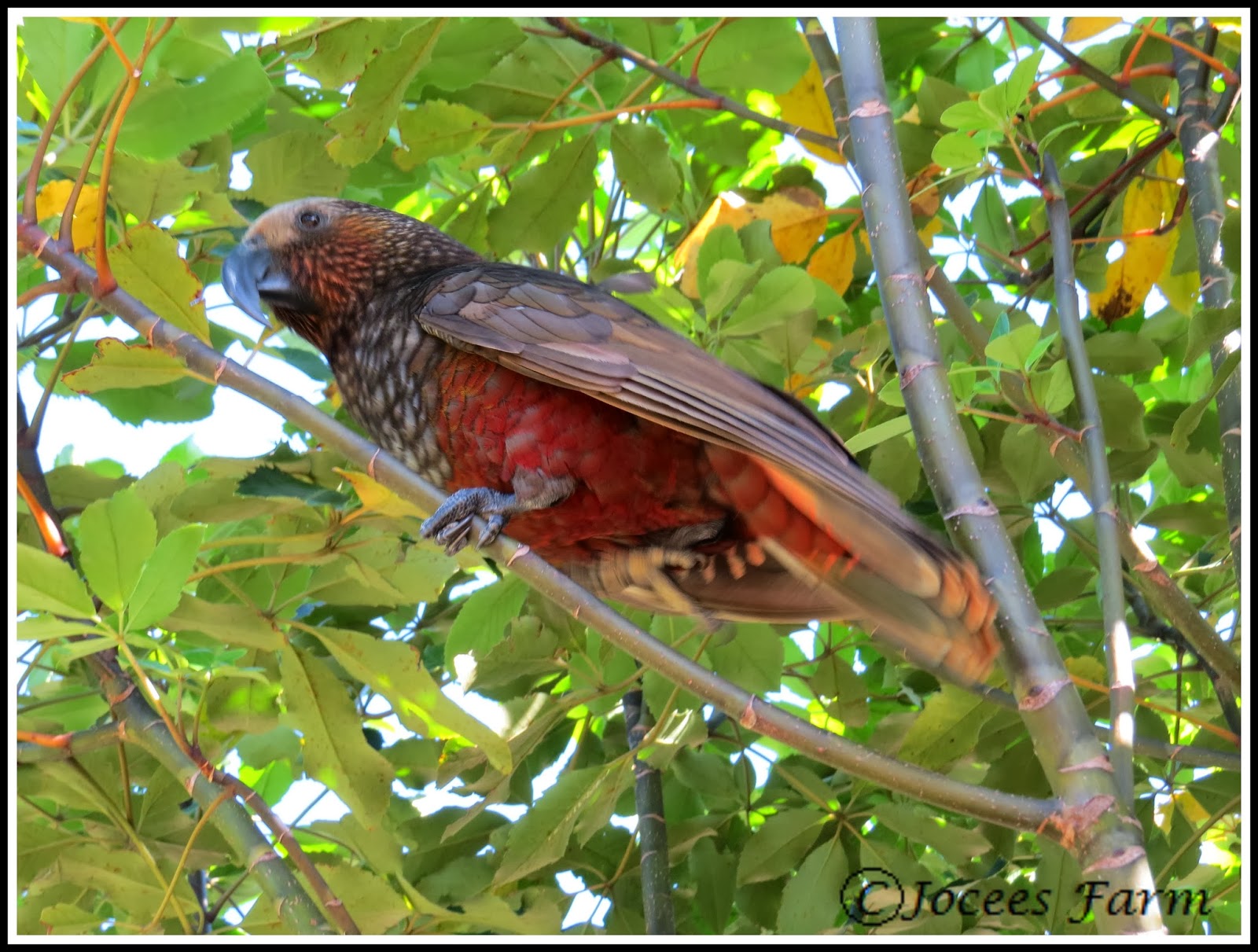
The Kaka

We got to meet this amusing and highly intelligent bird on our trip to Kapiti Island.  


This large New Zealand parrot has a reputation for solving problems - like how to get into your back pack.  They arrive out of the bush and start working on the zips.  It is amazing to watch how fast they can get them open and grab what's inside.


The North Island Kaka is approx 45cm long (almost 18in) and weighs about 475g.  Their South Island cousin is a bit bigger.


They eat berries, seeds, nectar, grubs and tourists belongings.  A very resourceful bird.


They are very entertaining to watch and are not afraid to land on hats, bags or shoulders.
  

The Kaka's are doing well on Kapiti Island as it is a nature reserve and all predators have been removed.


I'm linking to


Wednesday, 4 December 2013

Dining with Seagulls

We thought fish and chips on the beach was a good way to welcome the start of summer.

From out of nowhere the seagulls arrived.


They walked around us...


And hovered above us, until we could resist no longer and threw them a few chips.


I'm sharing with


Tuesday, 15 October 2013

The birds of the estuary

The rest of the residents at the estuary last week.


The Seagulls were all heading West, totally ignoring us and waiting for ...... something!?!


We checked out the famous Shag tree.  This is an old pine that has been half killed off by the birds that make their very haphazard nests in there.  They are breeding very well, and most of the nests had young ones in them.  


An adult Shag taking time out away from the breeding area.


A Canadian goose keeping an eye on me.


Where are these two off to?  I think someone is leading someone astray.


Wednesday, 9 October 2013

Black Swans

We went for a stroll around the local estuary and spotted these black swans and youngsters sorting out their swimming styles.


Sometimes it's a team effort to keep them under control.


Final instructions and head count.


As good as its going to get.


Wednesday, 2 October 2013

Shelduck - The final chapter

I was doubting the mating skills of the Paradise Shelducks that I had seen on the farm.  The bachelorette females and the lonesome male were living in separate paddocks, but obviously 2 of them got together because yesterday my daughter spotted a duckling.


The parents flew off and performed loudly to draw her away but she crept up and got some photos of 5 ducklings.


The were moving fast through the water and not stopping to pose for photos.


Then the decision was made to go over land......  Last seen heading north. 


I'm sharing with 


Wednesday, 11 September 2013

Found! Missing duck!

The Male Paradise Duck

Further to my story about the lonely bachelorette ducks, today I found a male Paradise Shelduck sitting on his own in the paddock.  


 Why?  I ask myself.  Does he have too many females to choose from and he needs a time out?


I left him while I moved the sheep, but on my return found him sitting on a fence post behind some flax bushes.
  

He honked at me a few times as I stood there.  I think the message was "Don't tell them where I'm hiding!"

Linking to Wild Bird Wednesday